

January 1 is not a particularly interesting day by itself, except to nurse whatever shenanigans were had the night before. Nor is it that interesting from a business point of view. It’s just another date on a new calendar full of hope for an upcoming year.
What does matter though, is what happens immediately after it: the first close of the year. There are new budgets and forecasts, updated bonding conversations, reporting that’s due to the bank, financial statement reviews and new jobs starting against a new annual plan.
That makes the final months of 2026 unusually valuable. They are a chance to fix financial problems while they still belong to this year instead of carrying them into the next one.
The question to ask now is:
What do you want your finance team to be able to tell you confidently when January arrives?
The Q4 finance calendar
The later you start, the less time there is to diagnose problems, clean up 2026 and put better processes in place before the first reporting cycle of 2027.
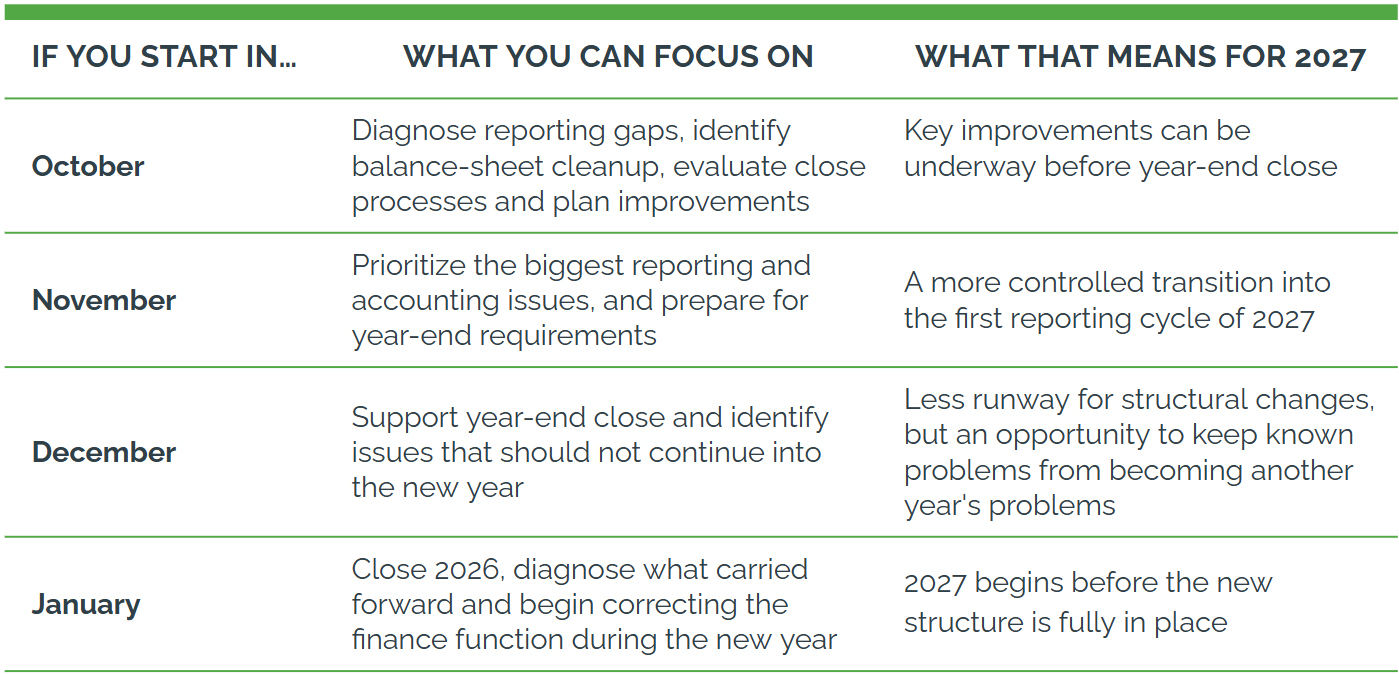
Starting earlier does not make the accounting easier. It gives you more choices about how to deal with it.
October: find out what needs attention
October gives leadership something scarce: room.
There is still time to look at the finance function before year-end becomes the finance function's full-time job.
For a medium-sized business, that means looking beyond whether the books are technically getting closed. Are key reports reconciled and understood? Are balance-sheet accounts supported? Can leadership explain margin changes? Are the schedules a CPA or lender will eventually request already being maintained?
This is the month to find the weak spots while there is still time to do something about them.
November: decide what needs to change this year
By November, the question becomes more practical.
Which issues need to be corrected before December 31, and which improvements can be designed now and implemented as the company moves into 2027?
This is also a useful time to look at whether the company's finance function still fits the size of the business.
December: don't make January inherit everything
December is usually not the month for an elaborate finance transformation.
It is the month to distinguish between what must be fixed now and what needs a deliberate plan for 2027.
If the close is going to expose accounting problems, know what they are. If schedules need to be rebuilt, start organizing them. If reporting is unreliable, determine why. If the company needs different financial leadership, define what is actually missing.
The objective is simple: don't let January discover December's problems for you.
January: the calendar resets. The books don't.
A new fiscal year can create the illusion of a clean slate, but unresolved accounting issues do not disappear when the calendar changes.
The same weak close process is still there along with all the undocumented procedures. Now they are competing for attention with the first close of 2027, new projects, new budgets and whatever else the business has planned for the year.
That is why the final months of the year matter.
They create an opportunity to enter January already knowing where the financial risks are, what needs to change and who is responsible for changing it.
What should be true by your first close of 2027?
For a growing company reaching beyond $20 million in annual revenue, a strong start to the year means leadership can trust the reporting enough to run the business and advance their goals.
You should be able to understand your profitability, support major balance-sheet accounts, explain significant changes in margins and cash, produce financial information for banks and investors, and close the books without the entire process depending on people and processes put in place when you were only bringing in $1 million.
So before Q4 disappears into year-end:
What would you rather fix in 2026 than explain in 2027?

James Wheeler
https://www.linkedin.com/in/jamesdavidwheeler/James Wheeler is a fractional CFO and the founder of kept.pro, which provides a proven outsourced accounting department model for growing companies with $2M–$50M in annual revenue. He brings 15+ years of executive finance leadership across services and technology businesses and was twice a finalist for the San Diego Business Journal’s CFO of the Year. James holds a BA in Economics and an MBA from UC San Diego, completed executive education at MIT Sloan, and has served on nonprofit and for-profit boards.