

Construction companies rarely decide to change their accounting function because the calendar says it is time. Usually something else forces the conversation.
Maybe a controller leaves or a new surety asks for better reporting. Certainly, the bank wants current, defensible financials. Maybe an outside CPA begins asking questions the internal team cannot answer or the company wins enough work that the accounting system that worked at $10 million suddenly feels very different at $30 million. Is anyone even sure the WIP reporting is correct?
The key question is: What does your finance function need to be capable of before the next pressure point arrives?
The construction finance calendar
The right time to strengthen the finance function depends on what is coming next.
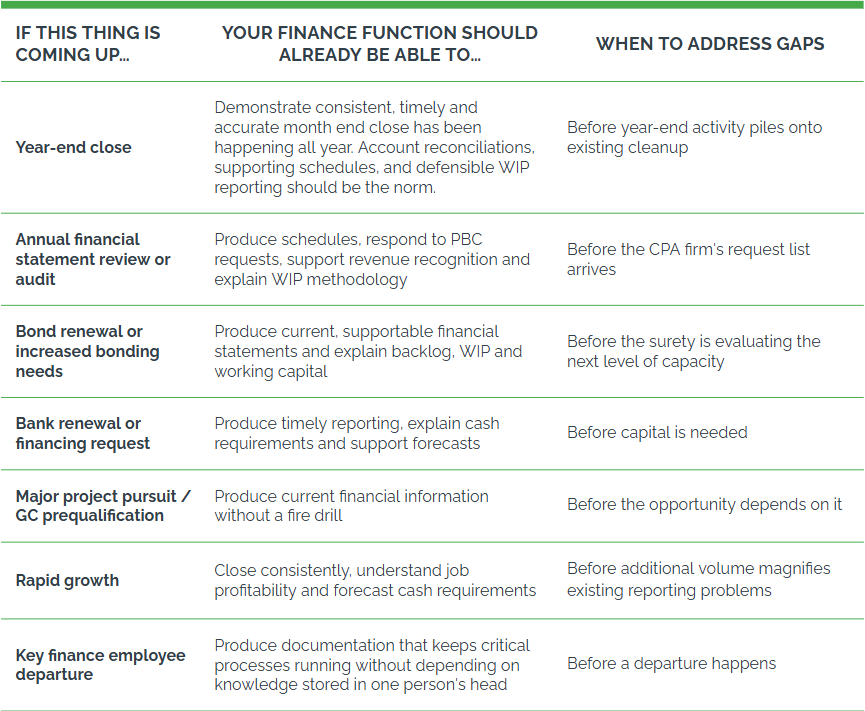
The common thread is simple: financial capability is most valuable when it exists before you have to have it.
Growth can hide an accounting problem
One of the stranger things (queue Running Up That Hill) about construction accounting is that a company’s field ops can get better at delivering growth while its financial infrastructure fails to support that growth.
Revenue grows, the backlog gets bigger and projects increase in size, all while increased cash moves through the business. Meanwhile, the accounting department may still be operating with processes built for a much smaller scale.
At kept.pro, we have seen this firsthand. One company grew $6million in annual revenue while continuing to rely on the same bookkeeping practices that had worked when the business was smaller. Customer deposits were being recorded as revenue when received rather than as deferred revenue, no WIP adjustment was being recorded, creating a seven-figure liability that wasn’t reflected on the balance sheet. Once the business engaged with us, they passed their initial financial statements review by a regional CPA firm, and continued to grow past $35M/year in revenue..
The company ultimately needed more than accurate bookkeeping. It needed financial reporting that reflected the economics of the business well enough for the owner to understand its true profitability, liabilities and cash position.
The dangerous time to discover the gap
Consider what happens when a contractor discovers a reporting problem during a bond renewal, or when the bank requests information that takes weeks to assemble, or when the CPA's PBC list lands and nobody internally has the time or technical accounting experience to own it.
At that point, the company has two jobs:
- Fix the underlying finance problem.
- Meet an external deadline at the same time.
That combination is what turns a manageable transition into a fire drill.
The better window is earlier, when management still controls the timetable.
Talk with kept.pro about whether your current finance function is ready for what comes next.
Four questions to ask before the next deadline
You do not need to redesign the accounting department every year.
You do need to know whether the current system can support the next stage of the business.
Ask:
Could we produce lender- or surety-ready financials today without a scramble?
Can we explain what is happening in WIP and job profitability, not just produce the report?
If our strongest accounting employee left next month, what knowledge would leave with them?
If revenue increased 25% next year, would our finance function become stronger with scale or simply busier?
Those answers tell you more about timing than the month on the calendar.
Build the finance function before it becomes the constraint
A growing contractor does not need “more accounting” for its own sake.
It needs a finance function capable of supporting the things the business is trying to do: win larger work, increase bonding capacity, maintain lender confidence, manage cash, understand project economics and make decisions from numbers leadership trusts.
That transition is easier when it happens before the next external deadline forces it.
What will your financials need to prove about your business over the next 12 months?

James Wheeler
https://www.linkedin.com/in/jamesdavidwheeler/James Wheeler is a fractional CFO and the founder of kept.pro, which provides a proven outsourced accounting department model for growing companies with $2M–$50M in annual revenue. He brings 15+ years of executive finance leadership across services and technology businesses and was twice a finalist for the San Diego Business Journal’s CFO of the Year. James holds a BA in Economics and an MBA from UC San Diego, completed executive education at MIT Sloan, and has served on nonprofit and for-profit boards.